
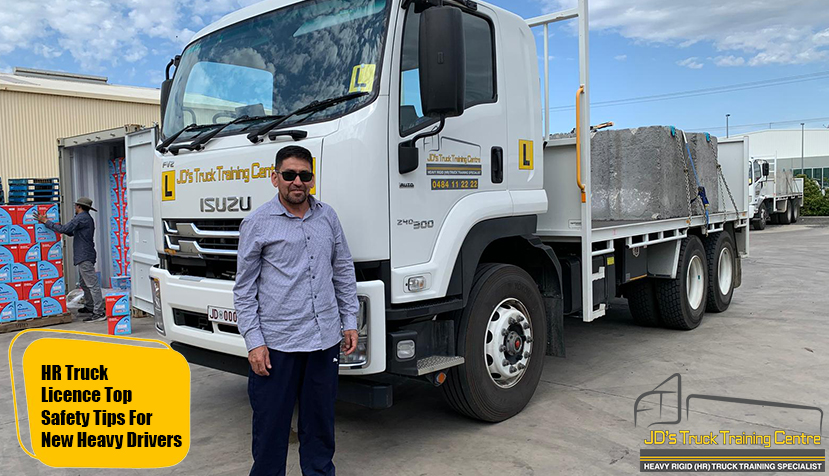
HR Truck Licence holders carry a significant responsibility every time they ignite the engine of a heavy rigid vehicle. Transitioning into the driver’s seat of a three-axle truck involves more than just a change in vehicle size; it requires a total shift in driving philosophy. Safety is the cornerstone of a successful trucking career, and for new drivers, the first few months are a critical learning period. By focusing on spatial awareness and defensive techniques, you can ensure that your journey in the transport industry is both long and accident-free.
Understanding Vehicle Dimensions and Blind Spots
Mastering your HR Truck Licence means acknowledging that you can no longer see the road the way you did in a sedan. Heavy rigid trucks have massive blind spots, often referred to as “no-zones,” located directly behind the vehicle, beside the cab, and immediately in front of the hood. You must check your mirrors every 5 to 8 seconds to maintain a 360-degree mental map of the traffic surrounding you. Always signal your intentions early to give smaller passenger vehicles ample time to react to your maneuvers.
The Importance of Speed and Space Management
When you undergo Heavy Vehicle Training Adelaide, instructors emphasize that momentum is a powerful force that works against you during sudden stops. A fully loaded heavy rigid truck can take up to 40% longer to stop than a car, especially in wet or slippery conditions. You must maintain a minimum four-second following distance from the vehicle in front. This buffer zone provides the necessary time to react to unexpected hazards without having to slam on the air brakes, which can lead to skidding or load shifting.
Navigating South Australian Terrain Safely
Engaging in Truck Training SA prepares you for the specific challenges of our local roads, from the steep descents of the Adelaide Hills to the busy intersections of the Port Adelaide industrial zones. One of the most vital tips for new drivers is to use “engine braking” when traveling downhill. Relying solely on your foot brakes can cause them to overheat and fail, a dangerous situation known as “brake fade.” Always select a lower gear before you begin a descent to let the engine’s compression control your speed safely.
Building Professional Habits Early
Training at JD’s Truck Training Centre helps you develop a disciplined pre-trip inspection routine that serves as your first line of defense against mechanical failure. Professional drivers never skip their walk-around checks, ensuring that tires, lights, and air lines are in perfect working order before hitting the highway. By identifying a loose wheel nut or a frayed belt in the yard, you prevent a minor issue from becoming a catastrophic breakdown in the middle of a busy delivery run.
Critical Safety Checklist for Beginners
To keep your safety record clean, integrate these essential habits into your daily driving routine:
- Avoid Distractions: Put your phone away and focus entirely on the road; a split second of inattention in a heavy truck can be fatal.
- Watch the Weather: Reduce your speed by at least 10-15 km/h when rain begins to fall, as oils on the road surface make it incredibly slick.
- Plan Your Route: Use truck-specific GPS tools to avoid low-clearance bridges, load-limited roads, and tight residential streets.
- Manage Fatigue: Recognize the signs of tiredness early—yawning or heavy eyelids are signals to pull over at the next safe rest area immediately.
Perfecting the Art of Cornering
Cornering in a heavy rigid vehicle requires a “slow in, fast out” approach to maintain stability. Because heavy trucks have a higher center of gravity, taking a turn too quickly can lead to a rollover, even if you stay within your lane. When the truck is still in a straight line, you should finish all of your braking. Then, as you start to come out of the curve, you should gradually accelerate. This technique keeps the weight of the vehicle distributed evenly across all axles and ensures the tires maintain maximum grip.
Becoming a professional driver is a rewarding path, but your success depends on your commitment to safety excellence. The skills you learn during your initial training form the foundation of your entire career. By partnering with a trusted provider like JD’s Truck Training Centre, you gain the high-level insights and practical experience needed to navigate the challenges of the road with poise. Remember, a great driver isn’t just someone who can move a truck from one point to another, but someone who ensures everyone on the road arrives home safely.
Read More: HR Drivers Licence Why Professional Training Is Critical For Safety